
 UK
UK


Pay by Mobile casinos
The 5 best-scoring casinos that take Pay by Mobile
Ranked by our 100-point score among the casinos whose own banking pages name Pay by Mobile for deposits. None of these 5 publishes a withdrawal list that names Pay by Mobile, so check the cashier before relying on it to be paid. The order is the score, not the commission.





18+. Offers carry terms and may exclude Pay by Mobile deposits; the table below and how welcome-offer exclusions are read show which. How we are paid.
Deposit & withdrawal terms
| Casino | Deposit | Withdraw | Casino's payout time | Casino's cap |
|---|---|---|---|---|
| O'Reels | Yes | Not stated | average withdrawal time is under 4 hours | — |
| Aladdin Slots | Yes | Not stated | 72 hour pending period, then 1-3 working days (1-5 in the terms) | — |
| Online Casino London | Yes | Not stated | 72 hour pending period, then 1-3 working days (1-5 in the terms) | — |
| Fortune Mobile Casino | Yes | Not stated | — | — |
| Fruity King | Yes | Not stated | — | — |
Read from each operator's own banking page on the date shown, and reported as published — what "not stated" means and whose figures the last two columns are. Not our measurement: the rating method awards payout points only for a withdrawal we timed end to end.
What the regulators and Pay by Mobile's own documents say
EE states that spending on Premium Rate Services is limited to a maximum of £40 in a single transaction and £240 in a billing period, with the monthly limit combined across all Premium Rate Services. — ee.co.uk, read 13 October 2026.
EE lists gambling among the services that can be charged to an EE phone account as charge-to-bill services. — ee.co.uk, read 13 October 2026.
Vodafone states that the limit on charges to the mobile bill is £40 per transaction and £240 in a single billing period, and that once the limit is reached nothing else can be charged to the account that month. — vodafone.co.uk, read 13 October 2026.
Vodafone states that for Charge to Bill purchases the merchant is responsible for both billing and operational issues, and describes this position as mandated by UK regulation. — vodafone.co.uk, read 13 October 2026.
Boku's terms of service state that there are limits on the amount of charges per transaction, on subscriptions and for specified time intervals, imposed by Boku and wireless carriers, and that charges exceeding the limits may be rejected by Boku or the carrier. — boku.com, read 13 October 2026.
Boku's terms of service state that Boku is not required to issue refunds if a product or service does not meet expectations or the merchant does not fulfil its commitments. — boku.com, read 13 October 2026.
Boku's UK disclosure states that a customer still dissatisfied with Boku's handling of a complaint can escalate it to Ofcom, and that Ofcom does not investigate or resolve individual complaints. — boku.com, read 13 October 2026.
The Regulation of Premium Rate Services Order 2024 states that it comes into force on 1 February 2025; the Order was made by Ofcom under the Communications Act 2003. — legislation.gov.uk, read 13 October 2026.
Article 52 of the Regulation of Premium Rate Services Order 2024 provides that a record of the consumer's use of the remote gambling service (including information about wins and losses) and the consumer's account information (including the latest balance) must be made available at all times while the consumer is using the service. — legislation.gov.uk, read 13 October 2026.
Article 25 of the Regulation of Premium Rate Services Order 2024 lists a remote gambling service among the services whose promotion and marketing must clearly state that the service must not be used by any person under the age of 18. — legislation.gov.uk, read 13 October 2026.
Four questions decide what any method does to your money, and the answers for Pay by Mobile are in the blocks above: what to check before you deposit with any method.
The deposit goes on your phone account, not through a card
Paying by mobile means the deposit is charged to your phone account. One of the casinos we read describes the mechanism in plain terms on its own pages: you "utilise your phone number to bill deposits straight to your mobile bill or prepaid credit". Nothing else changes hands — no card number, no bank login, no wallet to register first.
Behind the button is a carrier billing provider rather than the casino itself. O'Reels names its one on the banking page — "Pay By Mobile (Fonix) – Allows deposits via your mobile phone bill" — and Fruity King calls the route PayViaPhone in its terms. Boku is the other name you will meet in Britain. Which provider sits behind a given casino rarely matters to the deposit, but it decides what the charge looks like on your bill.
The appeal is obvious on a phone. There is no card to fetch, no long number to type on a small keyboard, and nothing about the casino stored anywhere except your phone account. For a £10 deposit that takes seconds, this is the least friction any method offers.
What it is not is a payment account. There is no balance to hold, no statement of its own, and nothing to reconcile: the amount simply appears on a bill you were already going to pay, or comes out of credit you had already bought.
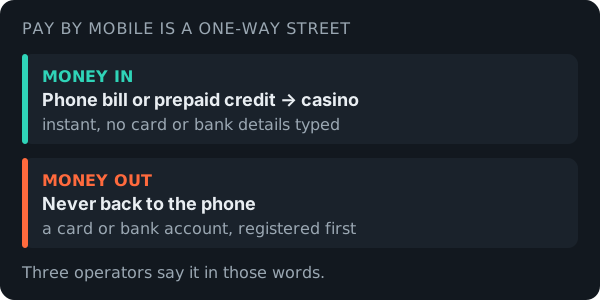
The rule that catches people out: money never comes back this way
A withdrawal cannot be sent to a phone bill. It is not a restriction one operator invented — three of the casinos in our catalogue put it in their terms in the same six words, and we read all three on 26 September 2026: "Withdrawals cannot be sent to 'Pay by Mobile'."
That leaves a gap in the middle of the account. You funded it with a method that cannot pay you back, so before any money can leave you have to register a second one — usually a debit card or a bank account — and it has to be in your own name, and it has to survive whatever verification the operator runs on it.
The practical consequence is a delay at exactly the wrong moment. A player who deposited in ten seconds by phone discovers at the point of a win that the payout route has not been set up, and the clock on verification starts then rather than a week earlier. Register the card when you open the account, not when you want the money.
It also interacts with a rule most operators apply to withdrawals: money goes back the way it came, as far as it can. With a phone deposit there is no "way it came" to return to, so the operator falls back to your nominated account — which is another reason to make sure the nominated account is the one you actually want the money in.
What it costs, and why that is unusual
Most payment methods at a British casino are free to use. Pay by mobile is the one where a fee turns up, and it is charged by the casino rather than hidden in an exchange rate.
Hyper Slots states it in the banking section of its terms, in the same list item as the method: "Pay by Mobile. All deposits incur a £2.50 transaction fee." On a £10 deposit that is a quarter of the money gone before a single spin. On the same site every other method is free.
Not every operator charges, and the ones that do not say so rarely advertise the fact. The rule of thumb is to look for the method in the banking terms rather than on the deposit screen: a fee that exists is written into the terms, and a deposit screen that shows the total only after you commit is not the place to discover it.
Weigh the fee against the size of the deposit rather than against the convenience. A fixed £2.50 is trivial on £100 and punishing on £10, and the players most likely to use this method are the ones depositing the smaller amount.
Limits are set by the carrier, not by the casino
A carrier billing provider caps what it will put on a phone account, and that cap is usually lower than a card limit by a wide margin. It exists because the network is extending you the money until the bill is paid, and because the account behind it was opened to buy phone service rather than to move funds.
We say that as the way the model works rather than as a figure we can quote at you. On the British casino pages we read, the operators publish their own minimum — £10 in a single transaction at the Jumpman sites — but none of them published the daily ceiling their provider applies. Where an operator does not state a number, we do not invent one; check it at the point of deposit, where the provider will tell you.
For most players the ceiling is academic. It matters in one situation: if you intend to deposit a larger sum and assume you can do it by phone, you may find the payment refused for a reason that has nothing to do with your balance or your bank.
Your phone bill can become a verification document
Verification usually asks for proof of the payment method as well as proof of you. With a card that means a photograph of the card; with a phone deposit it means the bill.
Fruity King writes the requirement into its terms: "If deposited via PayViaPhone please provide a photo of Your phone bill showing the mobile number that You have used with Us and Your full name." That is a document some people will not have to hand — a bill in your own name, showing the number you deposited from, rather than a screenshot of an app.
It is worth knowing before you deposit rather than after you win. If the phone is on a family or business account, or the bill arrives in somebody else's name, this is the point at which a withdrawal stops, and the fix involves the phone company rather than the casino.
A bill is not a credit card, and it is not quite cash either
Credit cards have been banned for gambling in Great Britain since 14 April 2020, for every form of remote betting and gaming. Paying on a monthly phone bill is not a credit card and the operators offering it hold British licences, so nothing here is being circumvented.
The effect on your own budgeting is still worth naming. A deposit on a contract bill is money you have not paid yet: the spend and the payment are separated by up to a month, which is precisely the distance that makes it easy to lose track of. Prepaid credit does not have that problem — the money is already gone — which is why the two options behave quite differently even though they sit behind the same button.
If a monthly bill is how you pay, the deposit limits on your casino account are doing more work than usual. Set them at the start. Every British licensee has to offer them, and this is the method where the gap between spending and paying is widest.
Who takes it, and when it is the right choice
Five casinos in our catalogue name pay by mobile on their own pages: Fortune Mobile Casino, Fruity King, O'Reels, Aladdin Slots and Online Casino London. The list below is built from those readings, each with the date we took it.
It is the right choice for a small deposit made on a phone by someone who is not in a hurry to withdraw, and who has already registered a card for the payout. It is the wrong choice as the only method on an account, because that account cannot pay you anything until a second one is added and verified.
And it is the wrong choice for the player it most appeals to — someone depositing £10 at a site charging £2.50 for the privilege — unless the convenience is genuinely worth a quarter of the stake.
What our own records show about Pay by Mobile
Of the 47 casinos in this catalogue whose banking and help pages we have read ourselves, 5 name Pay by Mobile, and 5 publish terms specific enough to put in the table above.
Not one of them states that Pay by Mobile receives withdrawals as well as deposits — which is a gap in their published terms rather than a finding about the method. The remaining 5 publish no withdrawal list at all, which is why the table says "not stated" rather than "no".
3 of the 5 publish any payout time for the account as a whole, and 0 publish a withdrawal cap — both are the casino's figures, not this method's.